
The dilogarithm  is a special case of the polylogarithm
  for
for  . Note that the notation
  is unfortunately similar to that for the logarithmic
integral
is unfortunately similar to that for the logarithmic
integral  .
There are also two different commonly encountered normalizations for the
.
There are also two different commonly encountered normalizations for the  function, both denoted
  , and one of which is known as the Rogers
L-function.
, and one of which is known as the Rogers
L-function.
The dilogarithm is implemented in the Wolfram Language as PolyLog[2, z].
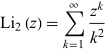
The dilogarithm can be defined by the sum
 |
(1) |
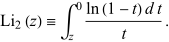
or the integral
 |
(2) |

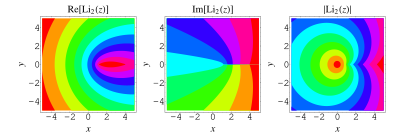
Plots of  in the complex plane are illustrated above.
The major functional equations for the dilogarithm are given by
A complete list of  with real arguments
  that can be evaluated in closed form is given by
where  is the golden ratio (Lewin 1981, Bailey et al.
1997; Borwein et al. 2001).
is the golden ratio (Lewin 1981, Bailey et al.
1997; Borwein et al. 2001).
Two-term identities involving irrational numbers include
 |
(19) |
(Lima 2012, Campbell 2021) and
where  is the golden ratio,
  is Catalan's constant,
and
is Catalan's constant,
and  is the trigamma
function (Campbell 2021).
is the trigamma
function (Campbell 2021).
W. Gosper (Sep. 19, 2021) gave the following identity for a dilogarithm with complex argument
![I[Li_2(i(sqrt(2)-1))]=(psi_1(1/8)+psi(3/8))/(32sqrt(2))+pi/(16)ln(3-2sqrt(2))-(pi^2)/(8sqrt(2)),](https://txtdot.deep-swarm.xyz/proxy/img?url=https%3A%2F%2Fmathworld.wolfram.com%2Fimages%2Fequations%2FDilogarithm%2FNumberedEquation4.svg) |
(24) |
where ![I[z]](https://txtdot.deep-swarm.xyz/proxy/img?url=https%3A%2F%2Fmathworld.wolfram.com%2Fimages%2Fequations%2FDilogarithm%2FInline75.svg) denotes the imaginary part of
denotes the imaginary part of  and
and  is the trigamma function.
There are several remarkable identities involving the dilogarithm function. Ramanujan gave the identities
(Berndt 1994, Gordon and McIntosh 1997) in addition to the identity for  , and Bailey et al. (1997) showed that
 |
(30) |
Lewin (1991) gives 67 dilogarithm identities (known as "ladders"), and Bailey and Broadhurst (1999, 2001) found the amazing additional dilogarithm identity
 |
(31) |
where  is the largest positive root of the polynomial in Lehmer's
Mahler measure problem and
is the largest positive root of the polynomial in Lehmer's
Mahler measure problem and  is the Riemann zeta
function.
is the Riemann zeta
function.
See also
Abel's Duplication Formula, Abel's Functional Equation, Clausen Function, Inverse Tangent Integral, L-Algebraic Number, Legendre's Chi-Function, Logarithm, Polylogarithm, Rogers L-Function, Spence's Function, Spence's Integral, Trilogarithm, Watson's Identities
Explore with Wolfram|Alpha
References
Abramowitz, M. and Stegun, I. A. (Eds.). "Dilogarithm." §27.7 in Handbook
of Mathematical Functions with Formulas, Graphs, and Mathematical Tables, 9th printing.
New York: Dover, pp. 1004-1005, 1972.Andrews, G. E.; Askey,
R.; and Roy, R. Special
Functions. Cambridge, England: Cambridge University Press, 1999.Bailey,
D. H.; Borwein, P. B.; and Plouffe, S. "On the Rapid Computation of
Various Polylogarithmic Constants." Math. Comput. 66, 903-913,
1997.Bailey, D. H. and Broadhurst, D. J. "A Seventeenth-Order
Polylogarithm Ladder." 20 Jun 1999. http://arxiv.org/abs/math.CA/9906134.Bailey,
D. H. and Broadhurst, D. J. "Parallel Integer Relation Detection:
Techniques and Applications." Math. Comput. 70, 1719-1736, 2001.Berndt,
B. C. Ramanujan's
Notebooks, Part IV. New York: Springer-Verlag, pp. 323-326, 1994.Borwein,
J. M.; Bradley, D. M.; Broadhurst, D. J.; and Lisonek, P. "Special
Values of Multidimensional Polylogarithms." Trans. Amer. Math. Soc. 353,
907-941, 2001.Bytsko, A. G. "Fermionic Representations for
Characters of  ,
,
 ,
,  and
and  Minimal Models and Related Dilogarithm and Rogers-Ramanujan-Type
Identities." J. Phys. A: Math. Gen. 32, 8045-8058, 1999.Campbell,
J. M. "Some Nontrivial Two-Term Dilogarithm Identities." Irish
Math. Soc. Bull., No. 88, 31-37, 2021.Erdélyi, A.; Magnus,
W.; Oberhettinger, F.; and Tricomi, F. G. "Euler's Dilogarithm." §1.11.1
in Higher
Transcendental Functions, Vol. 1. New York: Krieger, pp. 31-32,
1981.Gordon, B. and McIntosh, R. J. "Algebraic Dilogarithm
Identities." Ramanujan J. 1, 431-448, 1997.Kirillov,
A. N. "Dilogarithm Identities." Progr. Theor. Phys. Suppl. 118,
61-142, 1995.Lewin, L. Dilogarithms
and Associated Functions. London: Macdonald, 1958.Lewin, L.
Polylogarithms
and Associated Functions. New York: North-Holland, 1981.Lewin,
L. "The Dilogarithm in Algebraic Fields." J. Austral. Math. Soc. Ser.
A 33, 302-330, 1982.Lewin, L. (Ed.). Structural
Properties of Polylogarithms. Providence, RI: Amer. Math. Soc., 1991.Lima,
F. M. S. "New Definite Integrals and a Two-Term Dilogarithm Identity."
Indag. Math. 23, 1-9, 2012.Nielsen, N. "Der Eulersche
Dilogarithmus und seine Verallgemeinerungen." Nova Acta Leopoldina, Abh.
der Kaiserlich Leopoldinisch-Carolinischen Deutschen Akad. der Naturforsch. 90,
121-212, 1909.Watson, G. N. "A Note on Spence's Logarithmic
Transcendent." Quart. J. Math. Oxford Ser. 8, 39-42, 1937.
Minimal Models and Related Dilogarithm and Rogers-Ramanujan-Type
Identities." J. Phys. A: Math. Gen. 32, 8045-8058, 1999.Campbell,
J. M. "Some Nontrivial Two-Term Dilogarithm Identities." Irish
Math. Soc. Bull., No. 88, 31-37, 2021.Erdélyi, A.; Magnus,
W.; Oberhettinger, F.; and Tricomi, F. G. "Euler's Dilogarithm." §1.11.1
in Higher
Transcendental Functions, Vol. 1. New York: Krieger, pp. 31-32,
1981.Gordon, B. and McIntosh, R. J. "Algebraic Dilogarithm
Identities." Ramanujan J. 1, 431-448, 1997.Kirillov,
A. N. "Dilogarithm Identities." Progr. Theor. Phys. Suppl. 118,
61-142, 1995.Lewin, L. Dilogarithms
and Associated Functions. London: Macdonald, 1958.Lewin, L.
Polylogarithms
and Associated Functions. New York: North-Holland, 1981.Lewin,
L. "The Dilogarithm in Algebraic Fields." J. Austral. Math. Soc. Ser.
A 33, 302-330, 1982.Lewin, L. (Ed.). Structural
Properties of Polylogarithms. Providence, RI: Amer. Math. Soc., 1991.Lima,
F. M. S. "New Definite Integrals and a Two-Term Dilogarithm Identity."
Indag. Math. 23, 1-9, 2012.Nielsen, N. "Der Eulersche
Dilogarithmus und seine Verallgemeinerungen." Nova Acta Leopoldina, Abh.
der Kaiserlich Leopoldinisch-Carolinischen Deutschen Akad. der Naturforsch. 90,
121-212, 1909.Watson, G. N. "A Note on Spence's Logarithmic
Transcendent." Quart. J. Math. Oxford Ser. 8, 39-42, 1937.
Referenced on Wolfram|Alpha
Cite this as:
Weisstein, Eric W. "Dilogarithm." From MathWorld--A Wolfram Resource. https://mathworld.wolfram.com/Dilogarithm.html