
The polylogarithm  ,
also known as the Jonquière's function, is the function
,
also known as the Jonquière's function, is the function
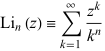 |
(1) |
defined in the complex plane over the open unit disk. Its definition on the whole complex plane then follows uniquely via analytic continuation.
Note that the similar notation  is used for the logarithmic
integral.
is used for the logarithmic
integral.
The polylogarithm is also denoted  and equal to
 |
(2) |
where  is the Lerch transcendent (Erdélyi et
al. 1981, p. 30). The polylogarithm arises in Feynman diagram integrals
(and, in particular, in the computation of quantum electrodynamics corrections to
the electrons gyromagnetic ratio), and the special cases
is the Lerch transcendent (Erdélyi et
al. 1981, p. 30). The polylogarithm arises in Feynman diagram integrals
(and, in particular, in the computation of quantum electrodynamics corrections to
the electrons gyromagnetic ratio), and the special cases  and
and  are called the dilogarithm
and trilogarithm, respectively. The polylogarithm
is implemented in the Wolfram Language
as PolyLog[n,
z].
are called the dilogarithm
and trilogarithm, respectively. The polylogarithm
is implemented in the Wolfram Language
as PolyLog[n,
z].
The polylogarithm also arises in the closed form of the integrals of the Fermi-Dirac distribution
 |
(3) |
where  is the gamma function, and the Bose-Einstein
distribution
is the gamma function, and the Bose-Einstein
distribution
 |
(4) |
The special case  reduces to
 |
(5) |
where  is the Riemann zeta function. Note, however,
that the meaning of
is the Riemann zeta function. Note, however,
that the meaning of  for fixed complex
  is not completely well-defined, since it depends on how
  is approached in four-dimensional
  -space.
The polylogarithm of negative integer order arises in sums of the form
where  is an Eulerian number. Polylogarithms also arise
in sum of generalized harmonic numbers
is an Eulerian number. Polylogarithms also arise
in sum of generalized harmonic numbers  as
as
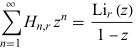 |
(8) |
for  .
.
Special forms of low-order polylogarithms include
At arguments  and 1, the general polylogarithms become
where  is the Dirichlet eta function and
  is the Riemann zeta
function. The polylogarithm for argument
is the Riemann zeta
function. The polylogarithm for argument  can also be evaluated analytically for small
  ,
,
No similar formulas of this type are known for higher orders (Lewin 1991, p. 2).  appears in the third-order correction
term in the gyromagnetic ratio of the electron.
appears in the third-order correction
term in the gyromagnetic ratio of the electron.
The derivative of a polylogarithm is itself a polylogarithm,
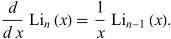 |
(18) |
Bailey et al. showed that
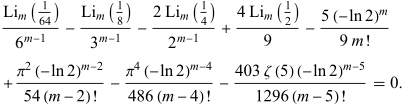 |
(19) |
A number of remarkable identities exist for polylogarithms, including the amazing identity satisfied by  ,
where
,
where  (OEIS A073011) is the smallest Salem
constant, i.e., the largest positive root of the polynomial in Lehmer's
Mahler measure problem (Cohen et al. 1992; Bailey and Broadhurst 1999;
Borwein and Bailey 2003, pp. 8-9).
(OEIS A073011) is the smallest Salem
constant, i.e., the largest positive root of the polynomial in Lehmer's
Mahler measure problem (Cohen et al. 1992; Bailey and Broadhurst 1999;
Borwein and Bailey 2003, pp. 8-9).
No general algorithm is known for integration of polylogarithms of functions.
See also
Dilogarithm, Eulerian Number, Legendre's Chi-Function, Logarithmic Integral, Multidimensional Polylogarithm, Nielsen Generalized Polylogarithm, Nielsen-Ramanujan Constants, Trilogarithm
Related Wolfram sites
http://functions.wolfram.com/ZetaFunctionsandPolylogarithms/PolyLog/
Explore with Wolfram|Alpha
References
Bailey, D. H.; Borwein, P. B.; and Plouffe, S. "On the Rapid Computation of Various Polylogarithmic Constants." Math.
Comput. 66, 903-913, 1997.Bailey, D. H. and Broadhurst,
D. J. "A Seventeenth-Order Polylogarithm Ladder." 20 Jun 1999. http://arxiv.org/abs/math.CA/9906134.Borwein,
J. and Bailey, D. Mathematics
by Experiment: Plausible Reasoning in the 21st Century. Wellesley, MA: A
K Peters, 2003.Borwein, J. M.; Bradley, D. M.; Broadhurst,
D. J.; and Lisonek, P. "Special Values of Multidimensional Polylogarithms."
Trans. Amer. Math. Soc. 353, 907-941, 2001.Berndt, B. C.
Ramanujan's
Notebooks, Part IV. New York: Springer-Verlag, pp. 323-326, 1994.Cohen,
H.; Lewin, L.; and Zagier, D. "A Sixteenth-Order Polylogarithm Ladder."
Exper. Math. 1, 25-34, 1992. http://www.expmath.org/expmath/volumes/1/1.html.Erdélyi,
A.; Magnus, W.; Oberhettinger, F.; and Tricomi, F. G. Higher
Transcendental Functions, Vol. 1. New York: Krieger, pp. 30-31,
1981.Jonquière, A. "Ueber eine Klasse von Transcendenten,
welche durch mehrmahlige Integration rationaler Funktionen enstehen." Öfversigt
af Kongl. Vetenskaps-Akademiens Förhandlingar 45, 522-531, 1888.Jonquière,
A. "Note sur la série  ." Öfversigt af Kongl.
Vetenskaps-Akademiens Förhandlingar 46, 257-268, 1888.Jonquière,
A. "Ueber einige Transcendente, welche bei den wiederholten Integration rationaler
Funktionen auftreten." Bihang till Kongl. Svenska Vetenskaps-Akademiens Handlingar 15,
1-50, 1889.Jonquière, A. "Note sur la série
." Öfversigt af Kongl.
Vetenskaps-Akademiens Förhandlingar 46, 257-268, 1888.Jonquière,
A. "Ueber einige Transcendente, welche bei den wiederholten Integration rationaler
Funktionen auftreten." Bihang till Kongl. Svenska Vetenskaps-Akademiens Handlingar 15,
1-50, 1889.Jonquière, A. "Note sur la série  ."
Bull. Soc. Math. France 17, 142-152, 1889.Lewin, L. Dilogarithms
and Associated Functions. London: Macdonald, 1958.Lewin, L.
Polylogarithms
and Associated Functions. New York: North-Holland, 1981.Lewin,
L. (Ed.). Structural
Properties of Polylogarithms. Providence, RI: Amer. Math. Soc., 1991.Nielsen,
N. Der Euler'sche Dilogarithms. Leipzig, Germany: Halle, 1909.Prudnikov,
A. P.; Marichev, O. I.; and Brychkov, Yu. A. "The Generalized
Zeta Function
."
Bull. Soc. Math. France 17, 142-152, 1889.Lewin, L. Dilogarithms
and Associated Functions. London: Macdonald, 1958.Lewin, L.
Polylogarithms
and Associated Functions. New York: North-Holland, 1981.Lewin,
L. (Ed.). Structural
Properties of Polylogarithms. Providence, RI: Amer. Math. Soc., 1991.Nielsen,
N. Der Euler'sche Dilogarithms. Leipzig, Germany: Halle, 1909.Prudnikov,
A. P.; Marichev, O. I.; and Brychkov, Yu. A. "The Generalized
Zeta Function  ,
Bernoulli Polynomials
,
Bernoulli Polynomials  ,
Euler Polynomials
,
Euler Polynomials  ,
and Polylogarithms
,
and Polylogarithms  ."
§1.2 in Integrals
and Series, Vol. 3: More Special Functions. Newark, NJ: Gordon and Breach,
pp. 23-24, 1990.Sloane, N. J. A. Sequence A073011
in "The On-Line Encyclopedia of Integer Sequences."Truesdell,
C. "On a Function Which Occurs in the Theory of the Structure of Polymers."
Ann. Math. 46, 114-157, 1945.Zagier, D. "Special
Values and Functional Equations of Polylogarithms." Appendix A in Structural
Properties of Polylogarithms (Ed. L. Lewin). Providence, RI: Amer. Math.
Soc., 1991.
."
§1.2 in Integrals
and Series, Vol. 3: More Special Functions. Newark, NJ: Gordon and Breach,
pp. 23-24, 1990.Sloane, N. J. A. Sequence A073011
in "The On-Line Encyclopedia of Integer Sequences."Truesdell,
C. "On a Function Which Occurs in the Theory of the Structure of Polymers."
Ann. Math. 46, 114-157, 1945.Zagier, D. "Special
Values and Functional Equations of Polylogarithms." Appendix A in Structural
Properties of Polylogarithms (Ed. L. Lewin). Providence, RI: Amer. Math.
Soc., 1991.
Referenced on Wolfram|Alpha
Cite this as:
Weisstein, Eric W. "Polylogarithm." From MathWorld--A Wolfram Resource. https://mathworld.wolfram.com/Polylogarithm.html