The least common multiple of two numbers  and
and  , variously denoted
  (this work; Zwillinger 1996, p. 91; Råde
and Westergren 2004, p. 54),
(this work; Zwillinger 1996, p. 91; Råde
and Westergren 2004, p. 54),  (Gellert et al. 1989, p. 25; Graham et
al. 1990, p. 103; Bressoud and Wagon 2000, p. 7; D'Angelo and West
2000, p. 135; Yan 2002, p. 31; Bronshtein et al. 2007, pp. 324-325;
Wolfram Language), l.c.m.
(Gellert et al. 1989, p. 25; Graham et
al. 1990, p. 103; Bressoud and Wagon 2000, p. 7; D'Angelo and West
2000, p. 135; Yan 2002, p. 31; Bronshtein et al. 2007, pp. 324-325;
Wolfram Language), l.c.m. (Andrews 1994, p. 22; Guy 2004, pp. 312-313),
or
(Andrews 1994, p. 22; Guy 2004, pp. 312-313),
or ![[a,b]](https://txtdot.deep-swarm.xyz/proxy/img?url=https%3A%2F%2Fmathworld.wolfram.com%2Fimages%2Fequations%2FLeastCommonMultiple%2FInline6.svg) ,
is the smallest positive number (multiple)
,
is the smallest positive number (multiple)  for which there exist positive integers
  and
and  such that
 |
(1) |
The least common multiple  of more than two numbers is similarly defined.
The least common multiple of  ,
,  , ... is implemented in the Wolfram
Language as LCM[a,
b, ...].
, ... is implemented in the Wolfram
Language as LCM[a,
b, ...].
The least common multiple of two numbers  and
and  can be obtained by finding the prime
factorization of each
can be obtained by finding the prime
factorization of each
where the  s
are all prime factors of
s
are all prime factors of  and
and  , and if
  does not occur in one factorization, then the corresponding
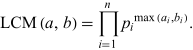
exponent is taken as 0. The least common multiple is then given by
does not occur in one factorization, then the corresponding
exponent is taken as 0. The least common multiple is then given by
 |
(4) |
For example, consider  .
.
so
 |
(7) |
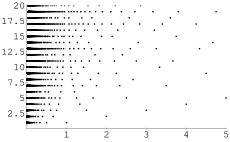
The plot above shows  for rational
  , which is equivalent to the numerator
of the reduced form of
, which is equivalent to the numerator
of the reduced form of  .
.
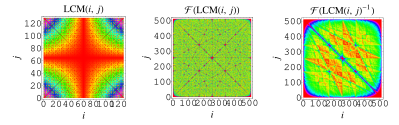
The above plots show a number of visualizations of  in the
  -plane. The figure on the left is simply
  , the figure in the middle is the absolute values of
the two-dimensional discrete Fourier transform
of
, the figure in the middle is the absolute values of
the two-dimensional discrete Fourier transform
of  (Trott 2004, pp. 25-26), and the figure at right is the absolute value of the
transform of
(Trott 2004, pp. 25-26), and the figure at right is the absolute value of the
transform of  .
.

The least common multiples of the first  positive integers for
  , 2, ... are 1, 2, 6, 12, 60, 60, 420, 840, ... (OEIS A003418; Selmer 1976), which is related to the
Chebyshev function
, 2, ... are 1, 2, 6, 12, 60, 60, 420, 840, ... (OEIS A003418; Selmer 1976), which is related to the
Chebyshev function  . For
. For  ,
,  (Nair 1982ab, Tenenbaum 1990). The prime number theorem implies that
 |
(8) |
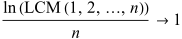
as  ,
in other words,
,
in other words,
 |
(9) |
as  .
.
Let  be a common multiple of
  and
and  so that
 |
(10) |
Write  and
and  ,
where
,
where  and
and  are relatively prime by definition of the greatest common divisor
  . Then
  , and from the division
lemma (given that
, and from the division
lemma (given that  is divisible by
  and
and  ), we have
  is divisible by
  , so
, so
 |
(11) |
 |
(12) |
The smallest  is given by
  ,
,
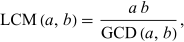 |
(13) |
so
 |
(14) |
The LCM is idempotent
 |
(15) |
 |
(16) |
 |
(19) |
and satisfies the absorption law
 |
(20) |
It is also true that
See also
Chebyshev Functions, Greatest Common Divisor, Least Common Denominator, Mangoldt Function, Multiple, Relatively Prime Explore this topic in the MathWorld classroom
Related Wolfram sites
http://functions.wolfram.com/IntegerFunctions/LCM/
Explore with Wolfram|Alpha
References
Andrews, G. E. Number Theory. New York: Dover, 1994.Bressoud, D. M. and Wagon,
S. A
Course in Computational Number Theory. London: Springer-Verlag, 2000.Bronshtein,
I. N.; Semendyayev, K. A.; Musiol, G.; and Muehlig, H. Handbook
of Mathematics, 5th ed. Berlin: Springer, 2007.D'Angelo, J. P.
and West, D. B. Mathematical
Thinking: Problem-Solving and Proofs, 2nd ed. Upper Saddle River, NJ: Prentice-Hall,
2000.Gellert, W.; Gottwald, S.; Hellwich, M.; Kästner, H.; and
Künstner, H. (Eds.). VNR
Concise Encyclopedia of Mathematics, 2nd ed. New York: Van Nostrand Reinhold,
1989.Graham, R. L.; Knuth, D. E.; and Patashnik, O. Concrete
Mathematics: A Foundation for Computer Science. Reading, MA: Addison-Wesley,
1990.Guy, R. K. "Density of a Sequence with l.c.m. of Each
Pair Less than  ."
§E2 in Unsolved
Problems in Number Theory, 3rd ed. New York: Springer-Verlag, pp. 312-313,
2004.Jones, G. A. and Jones, J. M. "Least Common Multiples."
§1.3 in Elementary
Number Theory. Berlin: Springer-Verlag, pp. 12-13, 1998.Nagell,
T. "Least Common Multiple and Greatest Common Divisor." §5 in Introduction
to Number Theory. New York: Wiley, pp. 16-19, 1951.Nair,
M. "A New Method in Elementary Prime Number Theory." J. London Math.
Soc. 25, 385-391, 1982a.Nair, M. "On Chebyshev-Type
Inequalities for Primes." Amer. Math. Monthly 89, 126-129, 1982b.Råde,
L. and Westergren, B. Mathematics
Handbook for Science and Engineering. Berlin: Springer, 2004.Selmer,
E. S. "On the Number of Prime Divisors of a Binomial Coefficient."
Math. Scand. 39, 271-281, 1976.Sloane, N. J. A.
Sequence A003418/M1590 in "The On-Line
Encyclopedia of Integer Sequences."Tenenbaum, G. Introduction
à la théorie analytique et probabiliste des nombres. Publications
de l'Institut Cartan, pp. 12-13, 1990.Trott, M. The
Mathematica GuideBook for Programming. New York: Springer-Verlag, 2004. http://www.mathematicaguidebooks.org/.Yan,
S. Y. Number
Theory for Computing, 2nd ed. Berlin: Springer, 2002.Zwillinger,
D. (Ed.). "Least Common Multiple." §2.3.6 in CRC
Standard Mathematical Tables and Formulae, 30th ed. Boca Raton, FL: CRC Press,
p. 91, 1996.
."
§E2 in Unsolved
Problems in Number Theory, 3rd ed. New York: Springer-Verlag, pp. 312-313,
2004.Jones, G. A. and Jones, J. M. "Least Common Multiples."
§1.3 in Elementary
Number Theory. Berlin: Springer-Verlag, pp. 12-13, 1998.Nagell,
T. "Least Common Multiple and Greatest Common Divisor." §5 in Introduction
to Number Theory. New York: Wiley, pp. 16-19, 1951.Nair,
M. "A New Method in Elementary Prime Number Theory." J. London Math.
Soc. 25, 385-391, 1982a.Nair, M. "On Chebyshev-Type
Inequalities for Primes." Amer. Math. Monthly 89, 126-129, 1982b.Råde,
L. and Westergren, B. Mathematics
Handbook for Science and Engineering. Berlin: Springer, 2004.Selmer,
E. S. "On the Number of Prime Divisors of a Binomial Coefficient."
Math. Scand. 39, 271-281, 1976.Sloane, N. J. A.
Sequence A003418/M1590 in "The On-Line
Encyclopedia of Integer Sequences."Tenenbaum, G. Introduction
à la théorie analytique et probabiliste des nombres. Publications
de l'Institut Cartan, pp. 12-13, 1990.Trott, M. The
Mathematica GuideBook for Programming. New York: Springer-Verlag, 2004. http://www.mathematicaguidebooks.org/.Yan,
S. Y. Number
Theory for Computing, 2nd ed. Berlin: Springer, 2002.Zwillinger,
D. (Ed.). "Least Common Multiple." §2.3.6 in CRC
Standard Mathematical Tables and Formulae, 30th ed. Boca Raton, FL: CRC Press,
p. 91, 1996.
Referenced on Wolfram|Alpha
Cite this as:
Weisstein, Eric W. "Least Common Multiple." From MathWorld--A Wolfram Resource. https://mathworld.wolfram.com/LeastCommonMultiple.html