The two functions  and
and  defined below are known as the Chebyshev functions.

The function  is defined by
(Hardy and Wright 1979, p. 340), where  is the
  th prime,
  is the prime counting
function, and
is the prime counting
function, and  is the primorial. This function has the limit
 |
(4) |
and the asymptotic behavior
 |
(5) |
(Bach and Shallit 1996; Hardy 1999, p. 28; Havil 2003, p. 184). The notation  is also commonly used for this function (Hardy 1999, p. 27).

The related function  is defined by
where  is the Mangoldt function (Hardy and Wright 1979,
p. 340; Edwards 2001, p. 51). Here, the sum runs over all primes
is the Mangoldt function (Hardy and Wright 1979,
p. 340; Edwards 2001, p. 51). Here, the sum runs over all primes  and positive integers
  such that
  , and therefore potentially includes some primes multiple
times. A simple and beautiful formula for
, and therefore potentially includes some primes multiple
times. A simple and beautiful formula for  is given by
![psi(x)=ln[LCM(1,2,3,...,|_x_|)],](https://txtdot.deep-swarm.xyz/proxy/img?url=https%3A%2F%2Fmathworld.wolfram.com%2Fimages%2Fequations%2FChebyshevFunctions%2FNumberedEquation3.svg) |
(8) |
i.e., the logarithm of the least common multiple of the numbers from 1 to  (correcting Havil 2003, p. 184). The values of
  for
for  , 2, ... are 1, 2, 6, 12, 60, 60, 420, 840, 2520, 2520, ...
(OEIS A003418; Selmer 1976). For example,
, 2, ... are 1, 2, 6, 12, 60, 60, 420, 840, 2520, 2520, ...
(OEIS A003418; Selmer 1976). For example,
 |
(9) |
The function also has asymptotic behavior
 |
(10) |
(Hardy 1999, p. 27; Havil 2003, p. 184).
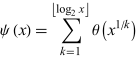
The two functions are related by
 |
(11) |
(Havil 2003, p. 184).
Chebyshev showed that 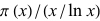 ,
,  , and
, and  (Ingham 1995; Havil 2003, pp. 184-185).
According to Hardy (1999, p. 27), the functions  and
and  are in some ways more natural than the prime
counting function
are in some ways more natural than the prime
counting function  since they deal with multiplication of primes instead
of the counting of them.
since they deal with multiplication of primes instead
of the counting of them.
See also
Mangoldt Function, Prime Counting Function, Prime Number Theorem, Primorial
Explore with Wolfram|Alpha
References
Bach, E. and Shallit, J. Algorithmic Number Theory, Vol. 1: Efficient Algorithms. Cambridge, MA: MIT Press,
pp. 206 and 233, 1996.Chebyshev, P. L. "Mémoir
sur les nombres premiers." J. math. pures appl. 17, 366-390, 1852.Costa
Pereira, N. "Estimates for the Chebyshev Function  ." Math. Comput. 44, 211-221,
1985.Costa Pereira, N. "Corrigendum: Estimates for the Chebyshev
Function
." Math. Comput. 44, 211-221,
1985.Costa Pereira, N. "Corrigendum: Estimates for the Chebyshev
Function  ."
Math. Comput. 48, 447, 1987.Costa Pereira, N. "Elementary
Estimates for the Chebyshev Function
."
Math. Comput. 48, 447, 1987.Costa Pereira, N. "Elementary
Estimates for the Chebyshev Function  and for the Möbius Function
  ." Acta Arith. 52, 307-337, 1989.Dusart,
P. "Inégalités explicites pour
." Acta Arith. 52, 307-337, 1989.Dusart,
P. "Inégalités explicites pour  ,
,  ,
,  et les nombres premiers." C. R. Math. Rep. Acad.
Sci. Canad 21, 53-59, 1999.Edwards, H. M. Riemann's
Zeta Function. New York: Dover, 2001.Hardy, G. H. Ramanujan:
Twelve Lectures on Subjects Suggested by His Life and Work, 3rd ed. New York:
Chelsea, p. 27, 1999.Hardy, G. H. and Wright, E. M. "The
Functions
et les nombres premiers." C. R. Math. Rep. Acad.
Sci. Canad 21, 53-59, 1999.Edwards, H. M. Riemann's
Zeta Function. New York: Dover, 2001.Hardy, G. H. Ramanujan:
Twelve Lectures on Subjects Suggested by His Life and Work, 3rd ed. New York:
Chelsea, p. 27, 1999.Hardy, G. H. and Wright, E. M. "The
Functions  and
and  "
and "Proof that
"
and "Proof that  and
and  are of Order
  ." §22.1-22.2 in An
Introduction to the Theory of Numbers, 5th ed. Oxford, England: Clarendon
Press, pp. 340-342, 1979.Havil, J. "Enter Chebyshev with Some
Good Ideas." §15.11 in Gamma:
Exploring Euler's Constant. Princeton, NJ: Princeton University Press, pp. 183-186,
2003.Ingham, A. E. The
Distribution of Prime Numbers. Cambridge, England: Cambridge University Press,
1995.Nagell, T. Introduction
to Number Theory. New York: Wiley, p. 60, 1951.Panaitopol,
L. "Several Approximations of
." §22.1-22.2 in An
Introduction to the Theory of Numbers, 5th ed. Oxford, England: Clarendon
Press, pp. 340-342, 1979.Havil, J. "Enter Chebyshev with Some
Good Ideas." §15.11 in Gamma:
Exploring Euler's Constant. Princeton, NJ: Princeton University Press, pp. 183-186,
2003.Ingham, A. E. The
Distribution of Prime Numbers. Cambridge, England: Cambridge University Press,
1995.Nagell, T. Introduction
to Number Theory. New York: Wiley, p. 60, 1951.Panaitopol,
L. "Several Approximations of  ." Math. Ineq. Appl. 2, 317-324, 1999.Robin,
G. "Estimation de la foction de Tchebychef
." Math. Ineq. Appl. 2, 317-324, 1999.Robin,
G. "Estimation de la foction de Tchebychef  sur le
  ième nombre premier er grandes valeurs de la fonctions
 ,
nombre de diviseurs premiers de
,
nombre de diviseurs premiers de  ." Acta Arith. 42, 367-389, 1983.Rosser,
J. B. and Schoenfeld, L. "Sharper Bounds for Chebyshev Functions
." Acta Arith. 42, 367-389, 1983.Rosser,
J. B. and Schoenfeld, L. "Sharper Bounds for Chebyshev Functions  and
and  ." Math. Comput. 29, 243-269, 1975.Schoenfeld,
L. "Sharper Bounds for Chebyshev Functions
." Math. Comput. 29, 243-269, 1975.Schoenfeld,
L. "Sharper Bounds for Chebyshev Functions  and
and  , II." Math. Comput. 30, 337-360, 1976.Selmer,
E. S. "On the Number of Prime Divisors of a Binomial Coefficient."
Math. Scand. 39, 271-281, 1976.Sloane, N. J. A.
Sequence A003418/M1590 in "The On-Line
Encyclopedia of Integer Sequences."
, II." Math. Comput. 30, 337-360, 1976.Selmer,
E. S. "On the Number of Prime Divisors of a Binomial Coefficient."
Math. Scand. 39, 271-281, 1976.Sloane, N. J. A.
Sequence A003418/M1590 in "The On-Line
Encyclopedia of Integer Sequences."
Referenced on Wolfram|Alpha
Cite this as:
Weisstein, Eric W. "Chebyshev Functions." From MathWorld--A Wolfram Resource. https://mathworld.wolfram.com/ChebyshevFunctions.html