
Two lines in two-dimensional Euclidean space are said to be parallel if they do not intersect. In three-dimensional Euclidean space, parallel lines not only fail to intersect, but also maintain a constant separation between points closest to each other on the two lines. Lines in three-space that are not parallel but do not intersect are called skew lines.
If lines  and
and  are parallel, the notation
  is used.
In a non-Euclidean geometry, the concept of parallelism must be modified from its intuitive meaning. This is accomplished by changing the so-called parallel postulate. While this has counterintuitive results, the geometries so defined are still completely self-consistent.
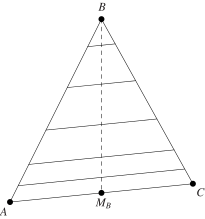
In a triangle  , a triangle median
  bisects all segments parallel to
a given side
bisects all segments parallel to
a given side  (Honsberger 1995, p. 87).
See also
Absolute Geometry, Antiparallel, Hyperparallel, Line, Non-Euclidean Geometry, Parallel Class, Parallel Computing, Parallel Curves, Parallel Line and Plane, Parallel Lines, Parallel Planes, Parallel Postulate, Parallel Transport, Parallel Vectors, Perpendicular, Plane, Series-Parallel Graph, Skew Lines, Surface of Revolution Parallel Explore this topic in the MathWorld classroom
Explore with Wolfram|Alpha
References
Honsberger, R. "Parallels and Antiparallels." §9.1 in Episodes in Nineteenth and Twentieth Century Euclidean Geometry. Washington, DC: Math. Assoc. Amer., pp. 87-88, 1995.Kern, W. F. and Bland, J. R. Solid Mensuration with Proofs, 2nd ed. New York: Wiley, p. 9, 1948.
Referenced on Wolfram|Alpha
Cite this as:
Weisstein, Eric W. "Parallel." From MathWorld--A Wolfram Resource. https://mathworld.wolfram.com/Parallel.html