
Two lines in two-dimensional Euclidean space are said to be parallel if they do not intersect.
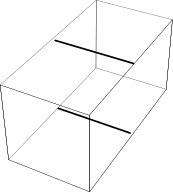
In three-dimensional Euclidean space, parallel lines not only fail to intersect, but also maintain a constant separation between points closest to each other on the two lines. Therefore, parallel lines in three-space lie in a single plane (Kern and Blank 1948, p. 9). Lines in three-space which are not parallel but do not intersect are called skew lines.
Two trilinear lines
are parallel if
 |
(3) |
(Kimberling 1998, p. 29).
See also
Café Wall Illusion, Coplanar, Intersecting Lines, Parallel, Parallel Curves, Parallel Line and Plane, Parallel Planes, Parallel Postulate, Perpendicular, Ponzo's Illusion, Proclus' Axiom, Skew Lines, Zöllner's Illusion
Explore with Wolfram|Alpha
References
Kern, W. F. and Bland, J. R. Solid Mensuration with Proofs, 2nd ed. New York: Wiley, p. 9, 1948.Kimberling, C. "Triangle Centers and Central Triangles." Congr. Numer. 129, 1-295, 1998.
Referenced on Wolfram|Alpha
Cite this as:
Weisstein, Eric W. "Parallel Lines." From MathWorld--A Wolfram Resource. https://mathworld.wolfram.com/ParallelLines.html