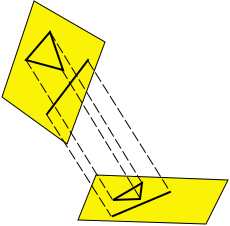
A projection is the transformation of points and lines in one plane onto another plane by connecting corresponding points on the two planes with parallel lines. This can be visualized as shining a (point) light source (located at infinity) through a translucent sheet of paper and making an image of whatever is drawn on it on a second sheet of paper. The branch of geometry dealing with the properties and invariants of geometric figures under projection is called projective geometry.
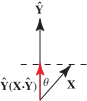
The projection of a vector  onto a vector
  is given by

where  is the dot
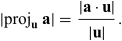
product, and the length of this projection is
is the dot
product, and the length of this projection is
General projections are considered by Foley and VanDam (1983).
The average projected area over all orientations of any ellipsoid is 1/4 the total surface area. This theorem also holds for any convex solid.
See also
Bicentric Perspective, Dot Product, Map Projection, Möbius Net, Point-Plane Distance, Projection Matrix, Projection Operator, Projection Theorem, Projective Collineation, Projective Geometry, Reflection, Shadow, Stereology, Trip-Let, Vector Space Projection, Vertical Perspective Projection
Explore with Wolfram|Alpha
References
Casey, J. "Theory of Projections." Ch. 11 in A Treatise on the Analytical Geometry of the Point, Line, Circle, and Conic Sections, Containing an Account of Its Most Recent Extensions, with Numerous Examples, 2nd ed., rev. enl. Dublin: Hodges, Figgis, & Co., pp. 349-367, 1893.Foley, J. D. and VanDam, A. Fundamentals of Interactive Computer Graphics, 2nd ed. Reading, MA: Addison-Wesley, 1990.
Referenced on Wolfram|Alpha
Cite this as:
Weisstein, Eric W. "Projection." From MathWorld--A Wolfram Resource. https://mathworld.wolfram.com/Projection.html