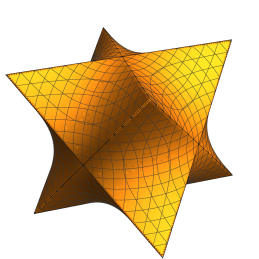
Consider the solid enclosed by the three hyperboloids specified by the inequalities
This work dubs this solid the "trihyperboloid."
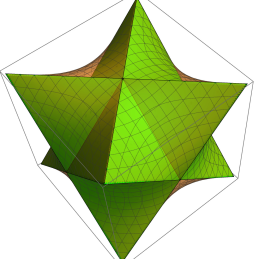
The basic shape of the trihyperbolid is that of a stella octangula with a "web" hung across adjacent faces.
The surface area of the trihyperboloid is given by
(OEIS A347903), where ![R[z]](https://txtdot.deep-swarm.xyz/proxy/img?url=https%3A%2F%2Fmathworld.wolfram.com%2Fimages%2Fequations%2FTrihyperboloid%2FInline25.svg) denotes the real part of
denotes the real part of  . The surface area can be given as a complicated
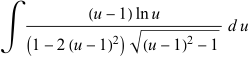
(but likely simplifyable) closed-form expression based on evaluation of the integral
. The surface area can be given as a complicated
(but likely simplifyable) closed-form expression based on evaluation of the integral
 |
(9) |
in terms of natural logarithms, dilogarithms, and trigamma functions (E. Weisstein Sep. 15-20, 2021).
Knill (2017) proposed as a challenge to Harvard summer school students that they prove that the volume was equal to  . The problem was solved by student Runze Li, who
gave the solution in terms of the mysterious integral
. The problem was solved by student Runze Li, who
gave the solution in terms of the mysterious integral
![I=1/2int_0^1[(z^2+1)(1/2pi-2tan^(-1)z)+z^2-1]dz,](https://txtdot.deep-swarm.xyz/proxy/img?url=https%3A%2F%2Fmathworld.wolfram.com%2Fimages%2Fequations%2FTrihyperboloid%2FNumberedEquation2.svg) |
(10) |
A more straightforward analysis was given by Villarino and Várilly (2021), who showed that
 |
(11) |
where  and
and  are the volumes of the two tetrahedra with common
face
are the volumes of the two tetrahedra with common
face  ,
,
 , and
, and  and apices
  and
and  and
and
Plugging in the values for  ,
,  , and
, and  then gives the expected result
 |
(14) |
(OEIS A257872).
See also
Hyperboloid, One-Sheeted Hyperboloid, Steinmetz Solid, Stella Octangula
Explore with Wolfram|Alpha
References
Knill, O. "Archimedes Revenge Solution." https://people.math.harvard.edu/~knill/teaching/summer2017/exhibits/revenge/.Sloane, N. J. A. Sequences A257872 and A347903 in "The On-Line Encyclopedia of Integer Sequences."Villarino, M. B. and Várilly, J. C. "Archimedes' Revenge." 6 Aug 2021. https://arxiv.org/abs/2108.05195. To appear in College Math. J.
Referenced on Wolfram|Alpha
Cite this as:
Weisstein, Eric W. "Trihyperboloid." From MathWorld--A Wolfram Resource. https://mathworld.wolfram.com/Trihyperboloid.html