Consider any star of  line segments through one point in space such that no three
lines are coplanar. Then there exists a polyhedron,
known as a zonohedron, whose faces consist of
line segments through one point in space such that no three
lines are coplanar. Then there exists a polyhedron,
known as a zonohedron, whose faces consist of  rhombi and whose edges are
parallel to the
rhombi and whose edges are
parallel to the  given lines in sets of
  .
Furthermore, for every pair of the
.
Furthermore, for every pair of the  lines, there is a pair of opposite faces whose sides lie in
those directions (Ball and Coxeter 1987, p. 141). A zonohedron is a therefore
a polyhedron in which every face is centrally symmetric (Towle 1996, Eppstein).
lines, there is a pair of opposite faces whose sides lie in
those directions (Ball and Coxeter 1987, p. 141). A zonohedron is a therefore
a polyhedron in which every face is centrally symmetric (Towle 1996, Eppstein).
There is some confusion in the definition of zonotopes (Eppstein 1996). Wells (1991, pp. 274-275) requires the generating vectors to be in general position (all
 -tuples of vectors must span the whole
space), so that all the faces of the zonotope are parallelotopes. Others (Bern et
al. 1995; Ziegler 1995, pp. 198-208; Eppstein 1996) do not make this restriction.
Coxeter (1973) starts with one definition but soon switches to the other.
-tuples of vectors must span the whole
space), so that all the faces of the zonotope are parallelotopes. Others (Bern et
al. 1995; Ziegler 1995, pp. 198-208; Eppstein 1996) do not make this restriction.
Coxeter (1973) starts with one definition but soon switches to the other.
While all zonohedra have Dehn invariant 0, only zonohedra that are parallelohedra are space-filling.
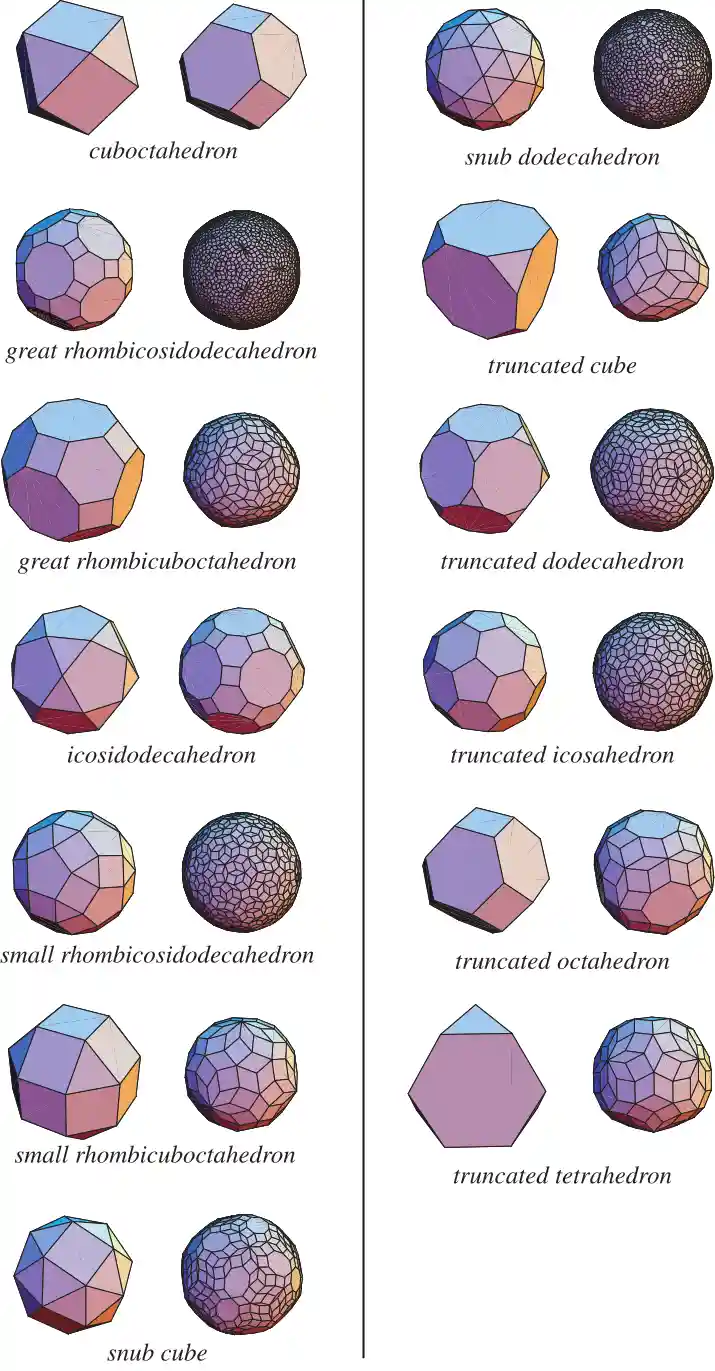
The figures above illustrate the Archimedean solids together with the zonohedra determined by their nonparallel vertices.
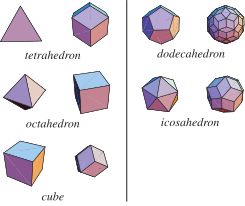
Similarly, the figures above illustrate the Platonic solids together with the zonohedra determined by the subsets of their vertices that are not antiparallel.
The combinatorics of the faces of a zonohedron are equivalent to those of line arrangements in the plane (Eppstein 1996).
If the line segments are all of equal length, the zonohedron is known as an equilateral zonohedron (Coxeter 1973, p. 29).
There exist  parallelograms in a nonsingular zonohedron, where
 is the number of different directions
in which polyhedron edges occur (Ball and Coxeter
1987, pp. 141-144).
is the number of different directions
in which polyhedron edges occur (Ball and Coxeter
1987, pp. 141-144).
Every convex polyhedron bounded solely by parallelograms is a zonohedron (Coxeter 1973, p. 27),
as is every convex polyhedron whose faces are
parallel-sided  -gons (Coxeter 1973, p. 29)
In addition to the equilateral and polar zonohedra, the parallelepipeds, primary parallelohedra (Coxeter 1973, pp. 29-30), and rhombohedra are zonohedra.
See also
Cube, Enneacontahedron, Equilateral Zonohedron, Golden Isozonohedron, Great Rhombicuboctahedron, Hypercube, Isozonohedron, Polar Zonohedron, Rhombic Dodecahedron, Rhombic Icosahedron, Rhombic Triacontahedron, Rhombohedron, Zonotope
Explore with Wolfram|Alpha
References
Ball, W. W. R. and Coxeter, H. S. M. Mathematical
Recreations and Essays, 13th ed. New York: Dover, pp. 141-144, 1987.Bern,
M.; Eppstein, D.; Guibas, L.; Hershberger, J.; Suri, S.; and Wolter, J. "The
Centroid of Points with Approximate Weights." Proc. 3rd Eur. Symp. Algorithms.
New York: Springer-Verlag, pp. 460-472, 1995.Coxeter, H. S. M.
"The Classification of Zonohedra by Means of Projective Diagrams." J.
Math. Pures Appl. 41, 137-156, 1962.Coxeter, H. S. M.
"Zonohedra." §2.8 in Regular
Polytopes, 3rd ed. New York: Dover, pp. 27-30, 1973.Coxeter,
H. S. M. Ch. 4 in The
Beauty of Geometry: Twelve Essays. New York: Dover, 1999.Eppstein,
D. "Zonohedra and Zonotopes." http://www.ics.uci.edu/~eppstein/junkyard/zono/.Eppstein,
D. "Zonohedra and Zonotopes." Mathematica in Educ. Res. 5,
15-21, 1996. http://www.ics.uci.edu/~eppstein/junkyard/ukraine/ukraine.html.Eppstein,
D. "Ukrainian Easter Egg." http://www.ics.uci.edu/~eppstein/junkyard/ukraine/.Fedorov,
E. S. Nachala Ucheniya o Figurah. Leningrad, pp. 256-266, 1953.Fedorov,
E. S. "The Symmetry of Regular Systems of Figures." Zap. Mineralog.
Obsc. (2) 28, 1-146, 1891. Reprinted as Symmetry of Crystals. American
Crystallographic Assoc., 1971.Fedorov, E. S. "Elements of
the Study of Figures." Zap. Mineralog. Obsc. (2) 21, 1-279, 1885.
Reprinted Moscow: Izdat. Akad. Nauk SSSR, 1953. http://www.research.att.com/~njas/doc/fedorov.ps.Fedorov,
E. S. "Elements of the Theory of Figures." Imp. Acad. Sci., St.
Petersburg 1885. Reprinted Moscow: Izdat. Akad. Nauk SSSR, 1953.Fedorov,
E. S. Zeitschr. Krystallographie und Mineralogie 21, 689, 1893.Hart,
G. "Zonohedra." http://www.georgehart.com/virtual-polyhedra/zonohedra-info.html.Hart,
G. W. "Zonohedrification." Mathematica J. 7, 374-383,
1999. http://library.wolfram.com/infocenter/Articles/3881/.Hart,
G. W. "Zonohedrification." http://www.georgehart.com/virtual-polyhedra/zonohedrification.html.Kelly,
L. M. and Moser, W. O. J. "On the Number of Ordinary Lines Determined
by  Points." Canad. J. Math. 1,
210-219, 1958.Taylor, J. E. "Zonohedra and Generalized Zonohedra."
Amer. Math. Monthly 108-111, 1992.Towle, R. "Zonohedra."
http://personal.neworld.net/~rtowle/Zonohedra/zonohedra.html.Towle,
R. "Graphics Gallery: Polar Zonohedra." Mathematica J. 6,
8-12, 1996. http://library.wolfram.com/infocenter/Articles/3335/.Wells,
D. The
Penguin Dictionary of Curious and Interesting Geometry. London: Penguin,
1991.Ziegler, G. M. Lectures
on Polytopes. New York: Springer-Verlag, 1995.
Points." Canad. J. Math. 1,
210-219, 1958.Taylor, J. E. "Zonohedra and Generalized Zonohedra."
Amer. Math. Monthly 108-111, 1992.Towle, R. "Zonohedra."
http://personal.neworld.net/~rtowle/Zonohedra/zonohedra.html.Towle,
R. "Graphics Gallery: Polar Zonohedra." Mathematica J. 6,
8-12, 1996. http://library.wolfram.com/infocenter/Articles/3335/.Wells,
D. The
Penguin Dictionary of Curious and Interesting Geometry. London: Penguin,
1991.Ziegler, G. M. Lectures
on Polytopes. New York: Springer-Verlag, 1995.
Referenced on Wolfram|Alpha
Cite this as:
Weisstein, Eric W. "Zonohedron." From MathWorld--A Wolfram Resource. https://mathworld.wolfram.com/Zonohedron.html