Python Tutorial
Python Tutorial | Python Programming Language
Last Updated : 19 Feb 2026
Python is one of the most popular and widely used programming languages nowadays, because of its simplicity, extensive features and support of libraries. Python also has clean and simple syntax, which makes it beginner-friendly, while it also provides powerful libraries and frameworks that make it perfect for developers.
Our Python tutorial thoroughly explains Python basics and advanced concepts, starting with installation, conditional statements, loops, built-in data structures, Object-Oriented Programming, Generators, Exception Handling, Python RegEx and many other important concepts. This tutorial is designed for both beginners and working professionals.
What is Python?
Python is a general-purpose, dynamically typed, high-level, compiled, interpreted, garbage-collected, and purely object-oriented programming language that supports procedural, object-oriented, and functional programming.
Python Hello World Program
In Python, it is one line of code. It requires simple syntax to print 'Hello World'.
Why Learn Python?
Python provides many useful features, and these features make it the most popular and widely used language. Here, we have listed a number of essential features included in Python.
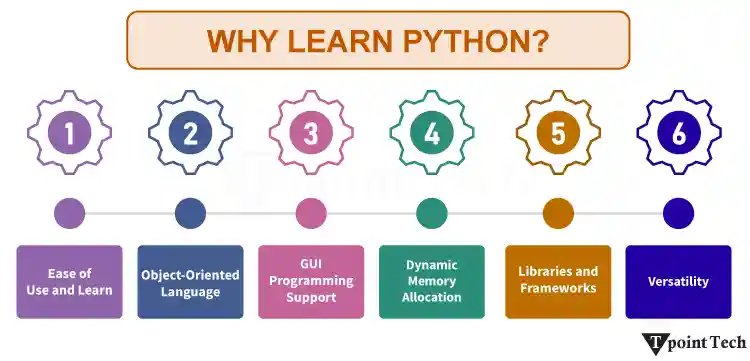
Ease of Use and Learn
Python has a simple and easy-to-understand syntax, unlike other languages such as C, C++, Java, etc., which makes it easier for beginners to learn. Also, it has several other features such as a Beginner-Friendly design, Several Standard libraries, community support, and High-level abstraction.
Object-Oriented Language
It supports object-oriented programming that enables a Python developer to write reusable and modular code easily. In addition, these features are really very helpful in developing scalable, highly maintainable, and reusable software.
GUI Programming Support
Python provides several GUI frameworks, such as Tkinter, PyQt, wxPython, and PySimpleGUI, which allow developers to create desktop applications easily. These features are very helpful in creating Widgets, Event-driven programming, Layout Management, and Event handling.
Dynamic Memory Allocation
Python automatically manages memory allocation, which makes it easier for developers to write complex programs without worrying about memory management. The key aspects include Automatic Memory Management, Heap Memory, and Dynamic Data Structures.
Libraries and Frameworks
Python has a large collection of libraries and frameworks, such as NumPy, Pandas, Django, and Flask. These frameworks are used in developing web applications and other fields like Backtrader, Robotics, Data Science, and Machine Learning, Web Scraping and API Interaction.
Versatility
Python's Versatility means it can be used in a wide range of domains and for several purposes. Its several key features are: General-Purpose language, Standard Library and Ecosystem, Readability and Simplicity, Supports Multiple Programming Paradigms, and Cross-platform compatibility.
Where is Python Used?
Python is a general-purpose, popular programming language, and it is used in almost every technical field. The various areas of Python use are given below.
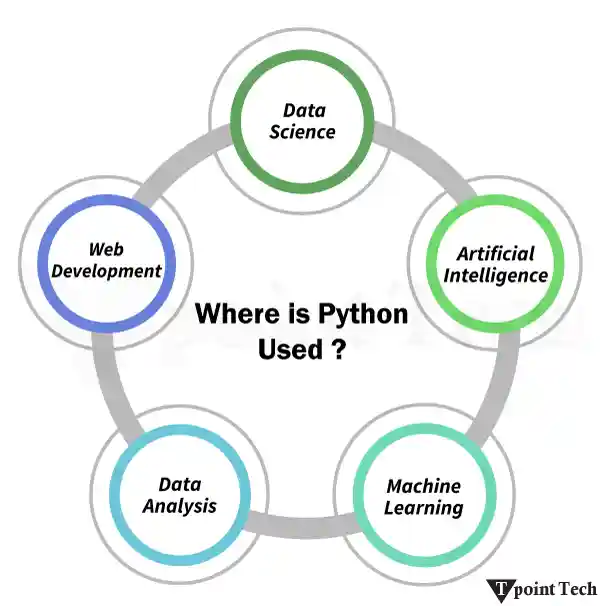
Data Science: Data Science is a vast field, and Python is an important language for this field because of its simplicity, ease of use, and availability of powerful data analysis and visualization libraries like NumPy, Pandas, and Matplotlib.
Artificial Intelligence: AI is an emerging Technology, and Python is a perfect language for artificial intelligence and machine learning because of the availability of powerful libraries such as TensorFlow, Keras, and Pytorch.
Machine Learning: Python is also widely used for machine learning because of its simplicity, ease of use and the availability of powerful machine learning libraries.
Data Analysis: Python is also used to create visualizations of data. It is also used to analyze price trends and market predictions and automate workflows across multiple data sources.
Web Development: Python is used to develop websites and web applications. There are several popular frameworks, like Django and Flask, which are used to build web applications.
Python Popular Frameworks and Libraries
Python has a wide range of libraries and frameworks widely used in various fields such as machine learning, artificial intelligence, web applications, etc. We define some popular frameworks and libraries of Python as follows.
- Web development (Server-side): Django, Flask, Pyramid, CherryPy
- GUI-based applications: Tkinter, PyGTK, PyQt, PyJS, etc.
- Machine Learning: TensorFlow, PyTorch, Scikit-learn, Matplotlib, Scipy, etc.
- Mathematics: NumPy, Pandas, etc.
- BeautifulSoup: This library is used in web scraping and parsing HTML and XML
- Requests: It is used for making HTTP requests
- SQLAlchemy: It is used in SQL databases
- Kivy: It is a framework for building applications
- Pygame: This library is used in the game development field
- Pytest: A testing framework for Python Django
- REST framework: This is a toolkit for creating RESTful APIs
- FastAPI: A modern, fast web framework for creating APIs
- Streamlit: A library for developing interactive web apps for machine learning and data science
- NLTK: It is a library for natural language processing
Python Basics
This section will cover the basic concepts of Python programming, including an introduction to Python, History, Python Applications, Installing Python, Hello World Program, Comments, Keywords, Literals, and operators.
- Python Tutorial | Learn Python Programming Language
- Python Features
- History of Python
- Top 10 Applications of Python Programming
- Python Install
- Python Example
- Python Comments
- Python Keywords
- Python Literals
- Python Operators
Python Variables and Data Types
This section of Python Tutorial covers some important topics such as understanding the Variables, Data types, Numbers, Type Casting, Strings, and Boolean.
Python Control Statements
In this section of the tutorial, we will discuss the control statements in detail with topics such as If-else, Loops, for loops, while loops, Break, and continue statements.
Python Data Structures
Python comes up with several data types, including lists, tuples, sets, and dictionaries. This section will describe each data type in detail and with examples to help you understand easily.
Python Functions
This section is going to discuss Python Functions in detail, with each topic, such as Functions, Built-in functions, Return Statement, Recursion, Lambda Functions, and Main Functions.
- Python Functions
- Python Built-in Functions
- Return Statement in Python
- Recursion in Python
- Python Lambda Functions
- Python Main Function
Python Modules
This section discusses Python Modules, which include Modules, List Comprehension, Collection Module, Math Module, OS Module, Random Module, Statistics Module, and Sys Module.
- Python Modules
- Python List Comprehension
- Python Collection Module
- Python Math Module
- Python OS Module
- Python Random Module
- Python Statistics Module
- Python Sys Module
Python Object-Oriented Programming (OOPs)
In this section, we'll describe the principles of object-oriented programming (OOP) in Python. We will discuss topics such as Object Class, Constructors, Inheritance, Abstraction, Encapsulation, and Access Modifiers.
- Python OOPs Concepts
- Python Object Class
- Python Constructors
- Python Inheritance
- Abstraction in Python
- Encapsulation in Python
- Access Modifiers in Python
Python Exception Handling
This section will explore Python Exception Handling topics such as how to catch Multiple unexpected errors, raise an exception, use the Finally Keyword in Python, and Built-in Exceptions.
- Python Exception Handling
- Python Catch Multiple Exceptions
- Python Raise an Exception
- Finally Keyword in Python
- Python Built-in Exceptions
Python File Handling
In this section, we will elaborate on file handling topics such as Python Files I/O, Read CSV file, Write CSV File, Read Excel File, Write Excel File, Context Manager, and Python JSON.
- Python Files I/O
- Python Read CSV File
- Python Write CSV File
- Python Read Excel File
- Python Write Excel File
- Context Manager in Python
- Python JSON
Python Advanced Topics
This section is going to discuss some advanced Python topics in detail, such as Python Decorators, Python Generators, Python Multiprocessing, Python Multithreading, Python Network Programming, and Socket Programming using Python.
- Python Decorators
- Python Generators
- Python Multiprocessing
- Python Multithreading
- Python Network Programming
- Socket Programming using Python
Python MySQL
In this section of the tutorial, we are discussing Python MySQL in detail, with each topic, such as Python MySQL Environment Setup, Python MySQL Database Connection, and other important topics, to have a better understanding of it.
- Python MySQL Environment Setup
- Python MySQL Database Connection
- Python MySQL Creating New Database
- Python MySQL Creating Tables
- Python MySQL Insert Operation
- Python MySQL Read Operation
- Python MySQL Update Operation
- Python MySQL Join Operation
- Python MySQL Performing Transactions
Python MongoDB
This section is going to discuss Python MongoDB connectivity in detail, with each topic, such as installation, creating a file, executing a script, Mongo Shell, checking databases, checking collections and accessing records.
Python SQLite
This section will discuss Python SQLite in detail, with each topic, such as installing Python, creating a table, inserting records, and selecting records.
Python Interview Questions
After covering all the topics, some important questions will help you prepare for an interview. Here, you will find the most important interview questions that cover topics like syntax, database connectivity, error handling, and advanced topics such as object-oriented programming.
Python MCQs
MCQs are a great way to test your knowledge of how much you have learned after learning all the Python concepts, including the basics and the advanced. These Python MCQs cover all the topics that we have learned in this tutorial.
Online Compiler
This Online Python Compiler will help you to write, compile, and execute Python programs without installing it on your local computer. This compiler runs directly in a web browser and is very useful for beginners, students, and developers who want to quickly test Python code.
Prerequisite
Before learning Python, you must have basic knowledge of programming concepts.
Audience
Our Python Programming tutorial is designed to help beginners and professionals.
Problem
We assure that you will not find any problem in this Python tutorial. But if there is any mistake, please post the problem in the contact form.